Monday, May 20, 2019

Body Beautiful, Seeing Is Not Believing

Having worked in the fitness industry now for the best part of 13 years, you’d imagine that I’d embrace working in fitness and fully feel like a part of it but in reality, this couldn’t be further from the truth. On one hand, I’m passionate about health / fitness and helping people to enjoy the benefits of an active and healthy lifestyle but on another hand, I feel absolute despair towards the messaging of how our industry represents itself and portrays what health and fitness actually is. How gyms promote the look of fitness, how personal trainers promote themselves. It feels like it’s become a soul-less and dishonest sector that constantly undermines any attempts to reach and help more people and ultimately be taken more seriously.

In simple terms, we use unsustainable, barely obtainable and extreme images of people to model the ideal of what health and fitness looks like. 

Firstly, health and fitness is more than just an appearance and it’s essential that we as an industry acknowledge this and more importantly, take full responsibility for educating people with the messaging we use, the priority we place on image, the way we set personal goals with people and ultimately create expectations. If not, we will continue to let people down and do ourselves no favours in driving our sector forward. Fitness is more than just a set of physical metrics but a feeling of being in control and a confidence of believing in your own habits.

Surely, the ideal approach as a fitness professional is to help encourage people towards a state of self-acceptance, confidence and nurturing a good long term relationship with both exercise and nutrition whereby they can enjoy all the benefits. And if we’re unable to do this effectively then perhaps we should be putting our hands in the air and clearly stating our own limitations whilst looking for ways of being better skilled until we’re able to do so.

Yet, this doesn’t seem to be happening. Rather than acknowledging our own shortcomings, we focus on the quick wins by exploiting the greatest vulnerabilities that people have. 

As an example, whilst the recommended guidelines that we work for health suggest certain ranges for body composition including muscle and fat, the people in the photos that we use are generally not in those healthy ranges and generally under-fat and over-lean so how we can be surprised that being healthy almost isn’t enough?! 

People are largely self-conscious with their appearance. Whilst I’d like to say I’m confident with myself, if you put me on a beach with a load of professional athletes, I’d likely be feeling pretty self conscious and I’m pretty certain I wouldn’t be alone yet actually, experience tells me that, many of the professional athletes would also be lacking in confidence in their own skin. Sounds bonkers but it’s true and I think part of the reason for this epidemic of poor self acceptance is that we’ve somehow ended up in a place where society (even the people in the glossy marketing pictures) feels like the sole measure of our state of health is in this almost unobtainable appearance used in marketing that we’re subjected to numerous times on a daily basis. Furthermore, there also seems to be a widely accepted belief that being in the kind of shape that society projects as the ideal of health and fitness is the key to happiness and self contentment. My thoughts differ significantly! 

And to explore my thoughts a little more, I approached a number of friends who’ve done fitness modelling in the past to get a little insight into how they felt when they were in the ‘shape of their life’, what sacrifices were made and how striving to achieving a certain look served them in the longer term. Thank you so so much for sharing your experiences.

Ali Winter


“I couldn’t socialise as there was too much temptation with food and drink. I missed out on family gatherings and if I did go anywhere I ALWAYS had 2 meals with me in my ‘tupperware’.

Mentally it didn’t serve me well as after the competitions had finished and I was back up to a decent level of body fat (20%)  (I had dropped to 12% as per my tanita scales) I thought I was obese and hated myself. I confined to weigh out all my food and was obsessed by counting macros. I ended up that unwell that I didn’t see what the point to life was and was under the care of a psychiatrist who diagnosed me with “disordered eating and body dysmorphia”.

Now, 5 years on whilst I’d love to be a little leaner and know I can be, I would only really do this by increasing my exercise and doing more conditioning than rather than restricting my food too much. I have a sweet tooth and chocolate is always on the agenda. 

From a professional perspective, if a potential client asked me to get them competition-ready or ultra lean I simply wouldn’t train them. There’s no balance to life when you’re in prep for competition, those 17 weeks of “dieting” (a word I absolutely hate in that context now) I did, had serious health consequences and I wouldn’t put myself or anyone through them again.”

Chris Kershaw


“I had to sacrifice socialising , probably some friendships and mostly my sanity. 

When I was at a very low body fat with the pressure of competition, I found it impossible to stay sane which resulted in a short-term binge eating disorder.

In terms of it being an aesthetic goal, this didn't really affect me. I just wanted to do well in my eyes. My first competition was one of the best days of my life for many reasons. Without that prep I wouldn't be the person I am today. It taught me a great deal and made me stronger.

I think everyone should get lean at least once to feel and know what it takes.” 

Tracey Dougan


“On this shoot I felt soooo disgustingly bloated and fat! Because the day prior I had competed (in bodybuilding) so I gorged so badly on all sorts of crappy food that people had given me for making it through to the finals. I felt fat, awful and no good enough”

Lewis Samardzija 


“The main sacrifice I made was certainly my social life! I missed 2 holidays with my friends and many birthdays and nights out. Although looking back now I could have maybe managed that better. 

In regards to health, 10 weeks in I lost my libido for 6 months. I think that this is not often discussed enough around natural athletes as it occurs very commonly. Binge eating 1-2 x per week from an emotional eating stand point where I would come home eat everything in the house bread, cereal until the point of almost vomiting and then the next day train for 3+ hours and get in saunas to try lose the gained weight.” 

It’s astonishing really that on one hand, we’re all chasing this ideal appearance and yet the very people in the pictures are pushing themselves to the absolute limits and feel anything but ideal.

So, rather than just rant and state what I consider to be the problems, I felt it only right to offer some suggestions on how you can avoid being pulled in by the smoke and mirrors of the industry that’s got your back when it comes to health and fitness:

  1. Firstly, when looking at glossy pictures of fitness models. Accept that you have no idea how that person felt at the time of the photo shoot, you know nothing about the sacrifices they had to make and whether or not they could sustain that appearance.
  2. Try to avoid setting personal goals that are exclusively image related. There is no real measure beyond opinion that can determine whether or not you’ve achieved your goal and in my experience, image-related goals can lead people towards a cycle of destructive obsession and distort what is truly important.
  3. Whatever you do and whatever goals you set, consider the impact on yourself and the people who are important to you, the time and sacrifice it will take and prioritise enjoyment.

Secondly, some pointers for us as the people working within the industry:

  1. When posting glossy images of fitness models, do so with honesty and integrity in a way that helps the viewer appreciate the truth behind what it takes to look that way. Protect the integrity of your messaging by exclusively using fitness models who reflect the healthy ranges for body composition.
  2. I also believe we need to separate out aspects of our industry including body building, crossfit and even many sports. In my mind, these can be extreme disciplines that demand unhealthy parameters and as such do not belong in the health and fitness industry. Each is a vehicle that can lead people to improvements in health and fitness but it’s important that we educate people better to make more informed decisions around the goals they set and paths they follow. I have a lot of respect for the levels of discipline that people demonstrate when preparing for competitions or a shoot but I do feel that without greater understanding and support, each can have significantly detrimental long term effects on health both in mind and body. 
  3. Don’t put so much pressure on yourself as a fitness professional to be perceived as the ultimate role model or be in the most incredible shape ever (whatever that means). Just be yourself and know that people will connect far greater with you when you’re true to yourself as opposed to trying to become a fitness robot. Be authentic, honest, open and well, human. Most people don’t (and shouldn’t feel like they need to) spend hours in the gym every day to achieve their goals - presenting this requirement creates a lot of pressure on you, creates an unrealistic ideal and shuts you off from the very people you aim to help. 

As a dad of 2 amazing girls (currently 7 and 3), I see such an incredible body confidence in them that helps them take on everything confidently and I’d love nothing more than them both keeping this for life.

I’d love your thoughts on this topic. Whether you’ve got a goal that you’re working towards, you’re struggling to gain motivation or you’re working in the industry, this is such a huge topic that impacts us all. 


And please feel free to share or tag a friend if you feel this can help anyone.

Thursday, November 12, 2015

Appearance, performance or health....the modern tussle of fitness goals

Good health is something that we all strive for, the holy grail that will help us enjoy long and prosperous lives. The question is, do we understand what good health is? 

In true essay fashion, I'm going to present my conclusion first and then try and explain why. I'm going to suggest that we don't understand good health. I'm also going to suggest there is not one single authority on the face of this planet greater than you able to help fully identify what your personal jigsaw of good health should look like. Because this is the thing - good health is a jigsaw, it's a matrix of many things and, it changes as well. Good health for you as a teenager would differ to good health for you in your forties. There are certain things that we can measure in health, and there are other things just as important that we can't. You can measure the health of your heart, your lung function, how strong you are, how high you can jump etc.… but can you accurately measure your happiness? I ask this because I'm certain we can agree how important your happiness is to your health. 

The reason I’m confronting this point is that working in the fitness industry, it strikes me that people ultimately want good health (I've certainly never met someone chasing bad health). However, the reality of health alone perhaps isn’t as appealing as losing weight, ‘shredding’, bulking up or being the strongest, fastest or best in a particular field. Ironically it really should be, but there’s little thrill in sustaining good health compared to dropping a dress size or hitting a PB. 

This kinda thing is becoming increasingly common on social media...motivational?? (this isn't me!)

So, why is there a tussle and what separates appearance and performance with health? Confusingly I'm going to suggest there is separation between the 3, but also connection. In my opinion, performance and appearance are related to health but the more extreme they become, the further you move away from health. We idolise sporting athletes but the reality of top level performers is that it’s very extreme, almost beyond health if you like. Many retired sportsmen and women suffer lifelong injuries, health implications and even psychological issues due to the intensity, physical demands and pressure of performing at the top. 

Working in the fitness industry I would say that most people’s goals fall into the categories of appearance and performance,and there is absolutely nothing wrong with this. Without question we can measure both of them very easily and therefore determine whether or not someone has achieved a goal. This is more than just useful because it helps us as professionals understand whether or not a particular regime is effective, and it removes the subjective human nature of opinion. Another really positive factor is that having trackable goals and actually seeing progress will help generate excitement and perhaps get someone interested who previously had little motivation. However, there’s something deeper that we as an industry need to be aware of and have a responsibility for. As discussed already, the most appealing goals are often losing weight, ‘shredding’, getting massive etc and that is exactly what we sell as an industry. Marketing gurus get paid by the bucket load to appeal directly to the emotions that will make someone get their wallet out and pay. We use strong and aspirational images to give people a vision to work towards. Ultimately, what we are promoting is “be something that you’re not”. Can you see the danger? 


In the world we live in where so much importance is attached to image, appearance and social identity we need to be mindful of how we potentially impact a person’s relationship with their health, their body, with food and exercise. 

Returning to the definition of health. I would describe health as a balance of a number of aspects that lead to an overall positive state of wellbeing. However, we as an industry can be guilty of presenting an image of health being regular intense exercise, having rippling muscles and knocking back protein shakes at every spare opportunity. Is this really good health? 


As fitness professionals we must keep health at the heart of what we do but when setting yourself personal goals, you need to keep it at the forefront of your mind because when all is said and done, health is what really matters (physical AND mental). Goals are great little markers, milestones and opportunities to benchmark but they’re also temporary and often pretty superficial. Importantly, and irrespective to whatever the goal, they’re only ever a small piece of the health jigsaw. 

I could gas on for a long time on this topic but here’s my 5 top tips for making sure that your goals aren’t drifting too far from sustainable health. 

  • If you set a goal, be committed but avoid attaching too much importance to that particular goal. If you don’t achieve it, it’s not the end of the world.
  • Be excited by your goals.
  • Make sure the sacrifice isn’t too disruptive to your life. To commit to goals we often have to make choices that impact our lives and sometimes the people around us. However, if the level of sacrifice starts impacting relationships with loved ones negatively then does the goal need revisiting?
  • Take a breather between goals. We live in an obsessive culture…targets, targets, targets, timescales, deadlines…bloomin ‘eck (my yorkshireness) it gets exhausting!! Take some time to actually acknowledge your achievement and appreciate the hard work and commitment you’ve put in. 
  • Avoid letting your confidence be based upon your superficial self. Easy to say right!! Self worth and self esteem should not be based upon the body you wear (and other people’s opinions) but the person you are. 

Monday, January 16, 2012

Are you ready to be motivated?

by Phill Wright

My aim for this blog is that by the end, your answer to the title will be a resounding yes. If it's already yes, then I aim to help create an even more powerful yes.

I've not always been sporty or into fitness. As a young lad, I was never the most able on the sports field. However, I did possess an ability to push myself more than that of those around me. I remember doing the 400 meters in secondary school and coming second out of 8 competitors. On ability, there is no way I should have come second in that race but those with the talent seemingly didn't share that determination. I remember breathing so heavy on the final straight that I sounded like I'd just escaped from a smoke chamber. Teachers were a little worried that I was having some sort of asthmatic episode but after a couple of minutes, I was fine. (although admittedly it look a little longer for the redness in my cheeks to normalise)

As I said though, my childhood wasn't super sporty and it was only in my 20's that fitness became more of a passion. My school and student days were much more 'normal' although all school and progress reports shared one common theme...'Phillip is persistent'.

In NLP (Neuro-Linguistic Programming) terms, two types of motivational directions are identified. They suggest that people are either 'toward' motivated or 'away' motivated. 'Toward' motivated would be someone working towards a goal, let's say their first 10km road race. However, someone wanting to avoid diabetes would be considered as 'away' motivated. In my mind, motivated toward is a stronger and more positive driving force as in this situation, an individual would be looking and focussing forward and ahead in time.

Irrespective of this, I believe that there is much more to how we as people are motivated and ultimately, I see it is a choice, completely under our control. We decide how much effort we apply to tasks, how organised we are, how much we seek assistance when something is alien or taxing.

So how can you start motivating yourself? Now these aren't tips, they're choices. Pillars that have helped me overcome obstacles and I completely believe they apply for us all and could make a huge difference for you:


  • Set your goals - It doesn't need to be world conquering. This is a goal for you, no one else, you! Be SMART (specific, measurable, achievable, realistic, time bound) with it but also, check it weekly. If you're organised, be sure to schedule week on week how you'll stay on target. If you're not a diary person, just revisit once per week and decide how you're going to stay on track that week. Do it now though, don't read any further until you've set your goal and make a note of it.
  • Learn to be resilient - Just like the time you learnt to walk or ride a bike, learn not to give up until you get there. It doesn't matter how long it takes you or how many attempts, you will get there.
  • Start stretching your imagination - I'm not assuming that you haven't challenged yourself with your goal but in my experience, we tend to be a little cagey when setting goals. I want you to answer this question "Do you know what you're capable of?". Do you have any idea of where your potential lies? If I'm honest, I don't know where mine is but I most certainly will continue to step further towards it. Just because you haven't done it before doesn't mean it can't be done. As creatures, our instincts are to move forwards and we're at our happiest when we're achieving, it gives us a sense of purpose, self belief and self esteem.
  • Only listen to self talk if it offers you something positive - Unlike popular belief, self talking isn't a sign of madness. Well, if it is then we're all clinically nuts. Unsurprisingly, many people charge their self-comments with doubt and criticism, also known as limiting beliefs. If you're telling yourself that you can't do something, answer this "How the heck do you possibly know that you can't?, have you tried it?, tried it again? and not given up until you've figured out how to?" The answer is that you can. Thomas Edison discovered some incredible inventions but it also took him hundreds, almost thousands of failed attempts to get there. In fact, his thoughts express this point beautifully "Many of life's failures are individuals who did not realise how close they were to success when they gave up". 
  • Be what you expect from others - In the world we live, there are so many distractions, commitments and pressures that our sense of identity can be pulled, pushed, twisted, tied in knots and forgetting who we are is so easily done. If you expect and enjoy kindness from others, be kind. If you expect helpfulness from others, be helpful. If you expect love from others, be loving. What has this got to do with motivation? Being more in line with your own values will help your sense of happiness, purpose and help you stay settled in the world you build around you.
It does take continual effort but like anything in life, the more you do it, the easier it becomes and the less you need to think about it. 

I return to my original point, are you ready to be motivated?


Thursday, January 5, 2012

Get Results By Being Deliberate

Phill Wright, Director of Creating Chaos

No one likes wasting time. I am certainly no fan of willing time away with little outcome and I'm guessing you're of a similar mind.

In the time I've spent in the fitness industry, there has been a huge influx in the abundance of information, guidance, support and available services which is fantastic for consumers. Ultimately, more choice is available and the likelihood of people finding something they enjoy is much greater.

So why are there still so many people committing to varying types of fitness and clearly not getting the results they desire? Personally, I don't think it has much to do with actually what they're doing but more how they're doing it. I would most certainly suggest that some methods of conditioning are more effective than others but even more important than that is the approach, the way in which people select their state and execute exercise.

When you look into it, athletes, those with seemingly unobtainable bodies and levels of fitness do many similar exercises to most gym goers...squats, presses, pulls etc. Ok, the programme athletes have will be written most likely by an expert but the most significant difference is that they take it seriously. Every single repetition of every single exercise is done to the best of their ability, often quickly and with significant load but importantly, they completely focus on doing the exercise.

So here's a couple of pointers to help you get more from every ounce of exercise you do:

1. Before exercising, prepare your session and rid yourself of as many destractions as possible. (put your mobile on aircraft mode if necessary)
2. Challenge yourself. Your body benefits from exercise by adapting to the challenges that it faces. If there are no challenges, the benefits will be less.
3. Commit to improve your ability to execute the exercise(s). No matter how many times you've done it, there is always room for improvement.
4. Enjoy how much self belief you'll feel knowing that every minute you spend exercising is completely worthwhile and helping you achieve your goals

NB. With the above, I'm not dismissing the importance of enjoying exercise or social sports. This is crucial and if you don't enjoy it, try something else

Tuesday, November 15, 2011


Jenny Wright, OutFit director

Back in August I had some fantastic news – I’m pregnant!

As well as being overjoyed and extremely excited, I also felt a little scared. What will happen to my training? Will I get fat? Will I lose all my strength? Will I have to stop doing all the things I enjoy?
When I was past 12 weeks and able to tell others my good news, the next question after “when is it due?” was “so when are you going to give up all the exercise?”

The common train of thought amongst people is that pregnant women should be wrapped up in cotton wool and shouldn’t do much more than go for a gentle walk in terms of exercise. I knew that this couldn’t be right – pregnant animals in the wild don’t stop hunting, pregnant women in the olden days continued to work and hunt, and pregnant women now in developing countries continue to do manual work, walk miles and look after their families. Why should it be different here?


Those of you who know me will know that I am quite into my training (that’s probably an understatement). I enjoy being physically fit, and typically would train 2 to 3 times a day in a variety of ways – running, kettlebells, bodyweight circuits and hockey to name a few.

When my husband and I decided to start trying for a baby, I wanted to be as prepared as possible for what was about to happen to my body, and the changes I would inevitably have to make. I am fortunate in that I work in the fitness industry and therefore I have a number of experts and resources to go to.

To my surprise however, most trainers and instructors were very cautious about advising me about training during pregnancy. And those that had studied it were men and obviously could not fully understand the changes that occur to a woman during pregnancy.

I could only find articles stating that “you should not lift heavy weights”, “you should not over exert yourself”, “you should not raise your heart rate above a certain level”, “you should not do any balance work” and so on. What about the things I could do?

So I looked overseas for my information. I found a few blogs by fellow female kettlebell instructors in America who had continued to train during pregnancy and had a trouble free pregnancy and gave birth to a happy, healthy baby. This gave me hope, although being a bit of a geek; I still wanted to know the science behind exercising whilst pregnant.

I found a brilliant book by Doctor James F Clapp called 'Exercising Through Your Pregnancy'.

In it he details the research that has been done on the effects of training whilst pregnant (surprisingly little until about 30 years ago when he set up numerous research programmes), he described the physiological changes to the body that happen during pregnancy, and the effects of exercise on the body and the effects of exercise on a pregnant woman. The benefits of continuing to exercise are numerous, and mostly positive additive benefits to those which naturally occur to a pregnant woman.

A lot of the changes that occur during pregnancy make the body extremely efficient – more oxygen intake, more efficient at getting rid of heat, better heart rate regulation. All of these changes also occur to women who regularly exercise. Combining exercising with being pregnant adds positively to these effects; it improves the supply of glucose and oxygen to the baby (provided the mum eats adequately and regularly).

The fitter, stronger and healthier you are, the easier labour may be, the stronger the baby will be, and the easier it will be to get back to pre-pregnancy size and fitness.

there are certain things that need to be said here. My body is used to, and has been used to for years, the types of training that I do. It is not a good idea to start an exercise programme or new types of training when you’re pregnant; and if you feel any pain or have any complications during pregnancy – always consult your doctor or midwife before continuing training.

The most important thing to understand is that it is not the time for pushing myself, or trying to beat personal records; I must listen to my body and if I’m feeling tired/exhausted/any pain, then I must stop or not try to train. I also must fuel my body properly – it’s not a case of “eating for two” (you only actually need an extra 300 calories a day, and this is only from 6 months onwards), it’s a case of eating healthy, nutritious foods that will enable the baby to develop and grow, but also sustain me through my training.

I am now 18 weeks pregnant, and I have continued to train most days throughout. I tend to do 20-30 minutes of kettlebell and bodyweight circuits in the morning before work, and then a long run including hills sprints or intervals with the dog after work.

If I feel too tired – I don’t train. The only thing I have stopped doing is playing hockey due to the physical nature and contact of the sport. I understand that when bump gets bigger I will have to slightly change and tailor my training to accommodate it. But unless I have any complications during my pregnancy – I will continue to do what I love doing. If I can’t train for some reason – I know that it is only for a few months, and most importantly – the baby now comes first. Nothing is more important to me than being able to give birth to a lovely healthy little boy or girl – that is something no amount of exercise can ever take the place of.


Sunday, April 24, 2011

The ridicous religion of health and fitness

I'm just sat up in Cumbria enjoying a couple of days break at Jen's family home and though I'd put together a quick blog.

With it being Easter weekend, for many a time of indulgence and for others a time for reflection, I thought I'd indulge in a little reflection myself.

With today marking the end of lent, I guess for those having given something up, it's a junction point, do I revert back to where I was? It's a decision that has to come from within, certainly if we're going to stick to it as we live in a free society and have the fortunate circumstance allowing us to decide for ourselves.

It certainly appears this way on the face of things, but is it really the case?

Whilst I love working in an industry that I have a clear passion about, there are certain parts to the industry that I don't understand...and if truth be told, I feel are very shameful. Whilst health and fitness is a personal investment that everyone should prioritise, not everyone has the knowledge or expertise to support themselves and rightfully so, many seek guidance. This demand for guidance creates space for thought-leaders and role models to steer people in the right direction. The shameful truth is that many 'role models' create dependancy from their subscribers. Instead of aiming to empower followers, a stronger reliance is forged through clever marketing, material that only seems to answer only a handful of questions and a continuance in a buying and selling mentality.

Having been in the fitness industry now for nearly 5 years (is that all???), I'm still figuring things out and have a lot to learn but what is very evident is that (and this applies to trainers and consumers) there is often almost sectarian splits between ideas and what people believe and follow. Now If I'm not mistaken, everyone seems to be after the same thing, good health, reducing the risks of illness and enjoying a fit and able body. So why all the segregation?

Well, it's good to have many different routes, ways and paths, there is no right or wrong way to live. However, the negativity stems from the sometimes hostile division between paths that we choose.

No one person on the face of this planet knows the answer to every question or has the perfect plan for everyone yet some of the so called role models would have you believe this. Many modern plans discuss going back to basics and living like cavemen. Whilst there are some extremely positive principles in this idea, is it not hypocritical idealism in the sense that unless you actually fully adopt the life of a caveman, (no computers, no internet, hunting for food etc) it would be nonsensical. Life has evolved from this stage and surely this a good thing. Maybe the theory isn't actually the problem but the fact that many people take ideas or concepts to extremes and follow them as they may a religion. Almost placing role models on a pedastal giving them an iconic or unhumanly status. In my understanding, this is not a positive step as it changes the dynamics completely. What was previously sticking to a healthy plan has now become an approved way of life ruled by a grand figurehead. Fitness shouldn't be so serious. It shouldn't be judged or judgemental and should be open to change as the circumstances of life do. Keeping it fun, vibrant and explorative helps people stay enthused and excited about fitness.

An unwelcomed observation is that often those who are followed overtly display dismissal or disapproval towards unaligned thoughts? Why? Is it fear of the unknown? Surely approval would inspire a more empowered and confident approach; leaving followers much more able to explore, learn and be better placed to make informed decisions. After all, as professionals, this is what we want isn't it!!??


- Posted whilst adventurising using BlogPress from my iPhone

Location:Cumbria

Tuesday, March 8, 2011

The 80-20 Rule

In the years that I've been in the fitness industry, I never cease to be amazed how people struggle to maintain a balance that keeps them where they want. That said, it is understandable. We live in a society that is jammed full of temptation and promise. A chocolate bar may well be advertised as the ultimate ticket to pleasure, feeling fantastic, sensual moments and all the rest of it but is the reality just the heightening of your taste buds. The chances are that it'll send you on a rollercoaster of feeling all great before slumping into a lull and possibly some bloatedness along the way.

There is no one super diet that fits all, regardless of what the watchers of weight may tell you or those that are clearly the biggest losers. The only way any plan will work long term is if it is sustainable and realistic for you. Exercising 3 or 4 times a day is not sustainable. Eating no carbs is not sustainable. Living off shakes is not sustainable. Instead, try and incorporate the 80-20 rule which I'm sure you've come across before. Basically, aim to be good and healthy at least 80% of the time and allow yourself treats and avoid complete abstainance of the things you enjoy. This doesn't mean becoming a binge-monster whereby you're a disciple of health 80% of the time and then spend the 20% bouncing between the king of burgers / the local cigarette factory and an off license. It sounds ridiculous but a lot of people have the midweek structure of work helping them create routine and then unleash the dragon come the weekend.


So, here's some tips that can help you get the most of the 80-20 rule:
  • Apply it to food. Try and cook or prepare your own meals 80% of the time and know what goes into what you eat. Vary your meals and get a balance of protein, carbohydrates and fats in each meal where possible.
  • Don't fully avoid the things you enjoy that maybe a little naughty. This can often lead to bigger cravings. Just be sensible with how much you have.
  • Think about how foods make you feel afterwards rather than during. Sometimes, the immediate satisfaction can push the knowledge of how foods leave you feeling. This can often help you avoid foods that your body reacts badly too which can link to allergies and intolerances.
  • Apply it to your exercise levels. Exercising all the time like some sort of robot doesn't do much more than put your body into a state of constant damage. You need repair time and recovery to benefit from exercise. Incorporate around 20% of your week to receovery.
Make sure you leave some comments and add your experiences. We all have experience that can help others

Monday, February 14, 2011

Incredible upper body conditioning circuit


Whilst I'm not the biggest fan of developing fitness for the sake of aesthetics but I know this is important for most. Not only does this mini upper circuit give you a strong and stable core, it will conditioning your stomach, arms, chest and upper back like no other work out and it's only 8 minutes long. No one has the excuse to say they can't fit 8 minutes in and you don't need any equipment.


To make it a little easier, just do the same exercises with your knees on the ground and look to keep the same full range of movement although if you start with part range, look to build it up gradually.

A billion times better than doing any bench or machine weights as it's true strength relative to your body.

Enjoy and if you don't have wobbly arms after this then you're a robot!!

Thursday, February 3, 2011

Top tips to keep you driven

The connection between intention and the follow through is fairly crucial, I'm sure we can all agree on that. When it comes to fitness, we see a distinct dislocation so often between what people set out to achieve and what they actually do achieve.

It's only February and all those New Year resolutions seem a thing of the distant past and the old habits that have haunted start to creep back in. Let's face it, we are creatures of habit, of this there is no denying. However, you are completely in control of the habits that you adopt and need not worry about being haunted by the old and often too easy habits creeping back in.

When it comes to setting goals and keeping yourself inline with your intentions, here are some top tips that will make your goals much smarter than those around you:

  • Be specific with your targets but more importantly, have an ongoing aim that runs continually alongside shorter and more specific aims. For example: I aim to always take the greener option and avoid using the car unless absolutely necessary. Unless you have back to back specific targets, once each one is done, there is no plan in place and you've all heard the 'failing to plan is planning to fail' saying. Another example may be that every year, I aim to try and learn a completely new type of exercise / activity.
  • Focus on your feelings more than numbers. Living in a world where statistics and quantities are all too readily available, we can often get far too obsessed with weight, body fat and other figures that can become the pinacle of self judgement. If you are going to make judgements of yourself then you'd need to be taking an unthinkable number of tests and assessments to make sure that the readings give you a fair and accurate reflection of your state of health. Make life easy and go on your feelings.
  • Take time on a regular basis to think about achieving and know exactly how it feels, how it makes you feel, how it looks in as much detail as possible. Make these details familiar and reflect upon them when you're not feeling at your strongest. This may be whilst reaching for a chocolate bar or whilst your struggling to finish your last press up. Strong feelings that have such positive attachement and meaning for you will work like a great weapon for you...you'll be surprised. This is similar to a rehearsal in sports and used by many that achieve on a high level. So much time is spent in preparation going through every possible detail. It may sound strange but prepare yourself to achieve.
  • Tell those that you love and trust. We all admire achievers and people who are driven and you'll be supported and respected for your goals...who knows, maybe you'll inspire. However, it's a bizarre human trait to feel fear of ridicule when it comes to having goals or aspirations. Know this...when we're born we have two intrinsic fears which are 'loud noises' and 'falling'. All other fears are learnt and fabricated. They don't serve a purpose!
Hope this helps and I look forward to your comments.

Monday, January 17, 2011

How To Use A Foam Roller Safely

More and more people have become aware of the benefits of using a foam roller so I thought I'd put together a quick guide on how to use them to properly. There are loads of great examples on YouTube showing how to actually use a foam roller to target specific muscles in the body. Here is a good example:


Whilst they are very good, it is worth knowing a little bit more than just how to roll on certain areas. Let me explain...foam rolling is all about targetting the myofascial tissue which effectively renders it a massage. Doing this is great as it's where tension builds up and soft tissue is often responsible for imbalances in posture / tightness and soreness. However, doing it in or around exercise can be dangerous without putting a few key elements into how you do it. When you foam roll a specific muscle, done properly will switch the muscle off so it stands to reason that switching a key muscle off prior to an exercise that requires that muscle could be risky.

Here is a simple structure for when foam rolling during or around exercise:
  1. Isolate - Target the specific muscle / muscle group that you're looking to roll and then work across the entire muscle length focussing on areas of greatest soreness
  2. Inhibit - Work between 45-90 seconds on that area to switch the muscle off and release the tension
  3. Activate - Reactivate that muscle by dynamic movements aimed to directly switch back on the muscle working through full range
  4. Integrate - Now integrate the muscle into bigger movement patterns that use the targetted muscle again focussing on full range and good form.
I'll be giving some full examples of this in a host of coming video-blogs that I'll be posting. Hope it all makes sense and fire those questions my way

Tuesday, January 11, 2011

Exercise - Nutrition - Commitment

These are the 3 pillars that we built our company on as, we knew right from the start that achieving success in health is getting the balance between the 3. Taking a stock-check of where you're at is simple and doesn't take any time whatsoever. Here are some really simple tips to make sure that the balance you have of all 3 is taking you in the right direction.


Exercise
  • You commit to a consistent regularity of activities on a weekly basis that includes aerobic exercise, strength activities, flexibility, core and balance. The American College of Sports Medicine (ACSM) guidelines suggest 3-5 aerobic sessions per week and 2 strength sessions. These of course can be merged together.
  • You enjoy the exercise / activities that you do and there is a continual degree of progression / challenge or variation to your activities. If you become bored or feel no progression, change what you do and try new things.
  • The activities don't leave you feeling constantly tired and run down. Recovery is as important as the exercise and the only way that you'll benefit from it.
  • Your activities don't put pressure on your relationships with family, loved ones or friends. Try and compromise to include friends and family within your activities and be willing to change what you do to make it accessible. 
Nutrition
  • How you feel with food can be one of the most telling measures of whether a particular food is good for you. If you feel wrotten after food then the chances are it's not a great choice for you. Always look to better understand which foods sit on your side of the fence.
  • Fuel your body with good clean foods and stick to the 80-20 rule. Eat healthy and well at least 80% of the time and treat yourself from time to time.
  • Drink water regularly.
  • Avoid lengthy gaps between meals or snacks. Fasting for long periods forces the body into a fat-storing state of starvation and unless you're looking to pile it on, try a grazing approach.
  • Eat slowly and balance your portion size. Slowing your eating will help you feel more in touch with when you feel full as well as help the digestion process. Eating until your absolutely stuffed is not the way forward.
  • Aim to vary the fruits and veg that you eat. Get a mixture of colours on your plate and avoid sticking to the same meals and foods constantly
Commitment
  • Without this, the other two elements will struggle. See your journey as exploring your own health and always stick to things that interest, excite and engage you.
  • Although how you see yourself may not seem relevant, we see commitment as mindset and attitude. Like what you see and look at the promise, potential and positives when you see yourself and everything that involves you. If you look in the mirror and dislike the reflection then don't expect weightloss or any transformation to change this fact. We can all connect image with confidence yet it's not the image but the perception of the image that influences confidence. Look at what you have and not what you haven't. Enjoy your capabilities and not things beyond. Believe in improvement.
  • Constantly learning will keep you fresh and vibrant. Equally, passing on your knowledge whilst helping others and teaching will help you develop your understanding.
  • Finally, the journey is always changing with times that are great and times that don't seem as productive. Take responsibility for yourself and everything that you experience and don't blame...not even yourself. Learn lessons, draw from experience and see things from as wide a perspective as possible. Use milestones and set goals but don't get bogged down into focussing on such microscopic details.
There is a lot of scope to make your own sense of what is written above and however that is will be right for you.

Monday, January 3, 2011

A new year - a time for change

An ideal way to mark my 50th blog by starting a brand new, untapped, year with 12 months of completely unchartered territory ahead.

Being new year, typically, people make a hatful of resolutions intending to make a new start for the year ahead and wash away the last. This is often a great thing and allows people to put some new and fresh focus into their lives, however, often in my experience, resolutions are filled with negative statements that include the very thing that people are looking not to do. For example - I'm not eating chocolate! This just puts the undesired activity into the forefront of the mind which isn't such a great idea as the unconscious mind doesn't process negatives. I remember as a child living near to garages that had 'No Ball Games' signs pinned up everywhere. What do you think all the children did? ...precisely what the sign didn't advise.

Here's some simple questions that can help you make sure that your fitness resolutions are strong, well geared and easy to follow. It's best to do this when on your own and with little distractions:


  1. Name an activity that you've either always wanted to do but have never done or you used to enjoy when you were younger and you haven't done in a while?
  2. What would make doing this activity even more enjoyable?
  3. Be brave and put a date to this activity. Month is fine but it's much better to specify the date
  4. If you could select the most ideal physical condition to enjoy this activity, what would it be? (the greater detail the better)
The answers to the above questions will have given you an incredible and powerful resolution that is completely goal specific. Just put them together now and break down some simple steps to help you on your way. 

By committing this to loved ones who you trust, you'll enjoy the support of those around you as well making you more committed to achieving.

Thursday, December 23, 2010

How are you at handling pressure?

We all have good days and not so good days and how we handle the not so good days often has an impact on our health. Sometimes it can even be a direct reflection of our state of health.

Yesterday turned out to be a series of unfortunate events for us, hence this blog. The recent extreme cold weather has been turbulant for so many and it hit us in force. A frozen pipe burst early on, then the freezer broke, then the pipes leaked in about 5 or 6 places flooding the back place and firing water in all directions and then the central heating decided to break down. Whilst it was fairly inconvenient and frustrating, panic just isn't one of my traits. Through the course of the events, there was always tasks that could help reduce the damage or make steps to a solution. In my experience, panicky people make poor decisions and tend not to think straight, I'll elaborate. I am fortunate enough to have served the country twice in the Middle East. Both visits were fairly intense times with a lot of missile attacks on our locations. It got to the point that some people became complacent that the assaults were inaccurate. To be fair, they often were as they were often poorly planned and rushed incidents. As a lead interpreter, I was given a task of showing a new 'terp' the ropes and taking them on an orientation of our base. Whilst at dinner in the mess tent, we came under heavy mortar fire with large shells landing within the camp and extremely close to our location with shrapnel ripping through the tent. The tent provided no protection whatsoever, the problem was that the tent was filled with over 100 soldiers and the exit was a single doorway. You can imagine the situation as dozens panicked running for the entrance, forgetting their armour, running back...it was chaos!

For me, the situation was my first of this kind but I managed to stay calm and get myself and the new and stunned 'terp' to hard cover quickly without panic.

I guess I'm particularly fortunate having this as an experience as I find it easy to put things into perspective. That situation could have been extremely different but I like to think I handled it pretty well.

Things go wrong, expectations get crushed, incidents happen and sometimes it's crucial to act quickly but being able to keep calm and a clear head will help you keep an awareness of what you can do. Panic is fuelled by worry which is focussing on the problem - this can really hamper reaching a solution.

You always have choice and options, make sure you use them.

I know in hindsight, the jets of water flooding our back place will become quite an entertaining story.


- Posted whilst adventurising using BlogPress from my iPhone

Location:Chapel Ln,Leeds,United Kingdom

Monday, December 13, 2010

The biggest mistake in Fitness

As a coach, I guess you can expect me to say that the specifics of the exercise are easy when it comes to staying in shape. It really is though. Even the nutrition can be relatively straight forward providing you don't have specific requirements. If this is the case, why don't that many people seem to achieve the results they so desire? Exercising 4-5 times a week is absolutely ample to either maintain shape or make the changes you want. Yet many people who do commit to this and in many cases even more, what stands in their way of achieving?

When I started out as a coach, I was so excited with all this knowledge I'd recently taken on, all I wanted to do was help people by giving them effective conditioning programmes yet, whilst all this knowledge was great, without one very important thing being right, it wouldn't really make a blind bit of difference. It's mindset!!

I'm not going to profess to always having been the most confident and empowered person. This isn't true. I was never the most physically able at school, in actual fact, chips, gravy and sausage took it's toll on me in my teenage years and everything I'm saying comes with personal attachment.

The thing is, we've all heard about the intrinsic link between mind and body. If you're aware of it but haven't really ever taken notice of it then it may be time to stop and take note. Think about it, in sport, how much does confidence affect performance? In football, when a team concedes a goal, you see their heads go down and this completely disaffects the way that they then play the game. It takes the real leaders / management and coaches to then pick their heads back up. A losing team can often start thinking about not letting another in rather than scoring another.

The good news is, in fitness, you're not having to compete against anyone else. It's just you versus you...you're body versus your mind? Yet, strangely enough, many people have a habit of looking around themselves in a gym or a fitness class and being intimidated by someone else. We've all heard those voices "I'm not that fit / I can't lift that much / I look awful compared to them / I'm never going to be that fit" Don't get me wrong, it can be motivating to work against others in a group context but do you really listen to those voices? If you do then prepare to not enjoy the benefits you should be getting. Those voices don't inspire, make you work as well as you can do or give you the confidence in yourself that you need to be at your best.

Approaching everything you do with focus, self belief and absolute certainty in yourself will make sure that whenever you're training, you're present in not just body but mind as well. It makes a difference...trust me!

If you're interested finding out more about motivation and simple things you can do to improve your mental focus then drop me an email phill@creatingchaos.co.uk

Tuesday, December 7, 2010

The Ultimate Stomach without sit ups - Part 4 of 4

Ok, it's been a few months since I started this series and hopefully long enough for you to have really embedded the fundamentals that I spelled out in:

If you haven't read through those then please take the time to and go through the suggested exercises.

This final step is simple. The golden rule is, use all the tips and techniques you've learnt from the previous articles and apply them to all exercises you do. It is easier to apply the principles for strength training or circuit training but you should still be able to engage them through many forms of CV training.

The most effective exercises that will really engage your abdominals like never before are compound movements that use the entirity of your body and in a variety of directions, movement types and circumstances. If you have a relatively good control over your body then why not try our own Primal Flow system. This is specifically based upon the workings of your stomach and hits every single major and minor muscle group giving you the most rounded conditioning of your stomach possible. No equipment needed. Follow to links to give them a go:

Upper and core conditioning and weight loss - Excellent for toned arms, chest, back, shoulders and one ripped stomach

Lower and core endurance - Perfect to tone legs, bum and stomach

If you find them tricky then try our free online facility which gives you the choice to select your ability level.

Please leave comments and let us know how you get on.

Wednesday, December 1, 2010

Safe exercises when it's snowy and icy

The winter showers seem to have painted the UK white over the last few days and hugely affected peoples plans, work and home life.

If you're finding that the snow is hampering your activity levels at the minute then make sure you read the 3 top ways of staying fit despite the big white outdoors:

  1. Get stuck in - You're never going to defeat the weather so you may as well accept that it'll do it's thing until it decides to do otherwise. Whilst it can be disruptive, snow provides a completely new dimension to training that other weathers just can't provide. Make sure you're wrapped as much as possible (waterproof gloves are best) and try some of the following. (30-40 minutes is plenty):
    • Make a snow man, why not make the biggest snowman/woman you've ever made and better yet, if you are near to another thumb twiddling person, get them involved. Either race to see who can make the biggest and baddest or make an almighty beast together. Incorporating deadlifting, pressing, pulling, twisting and squatting, this task hits all the major movement patterns.
    • Clear the path / drive of snow. It is probably best that you do this one when the snowfall has stopped to avoid frustration but shovelling your paths will not only provide you with a safer thoroughfare but it'll get you working pretty hard. Don't have a driveway? There must be a road nearby, clear a good 10-15 meters of it.
    • Go for an arctic hike. Make sure you are well wrapped up and take some water too. This is better and safer than running in the snow as it is not just slippy but hugely uneven and every step is a gamble whilst not being completely certain of what lies below the snow. Not only will hiking in snow get you working even harder than normal hiking with the deep surface but it'll engage your stomach more with every step having to come higher and further to the front.
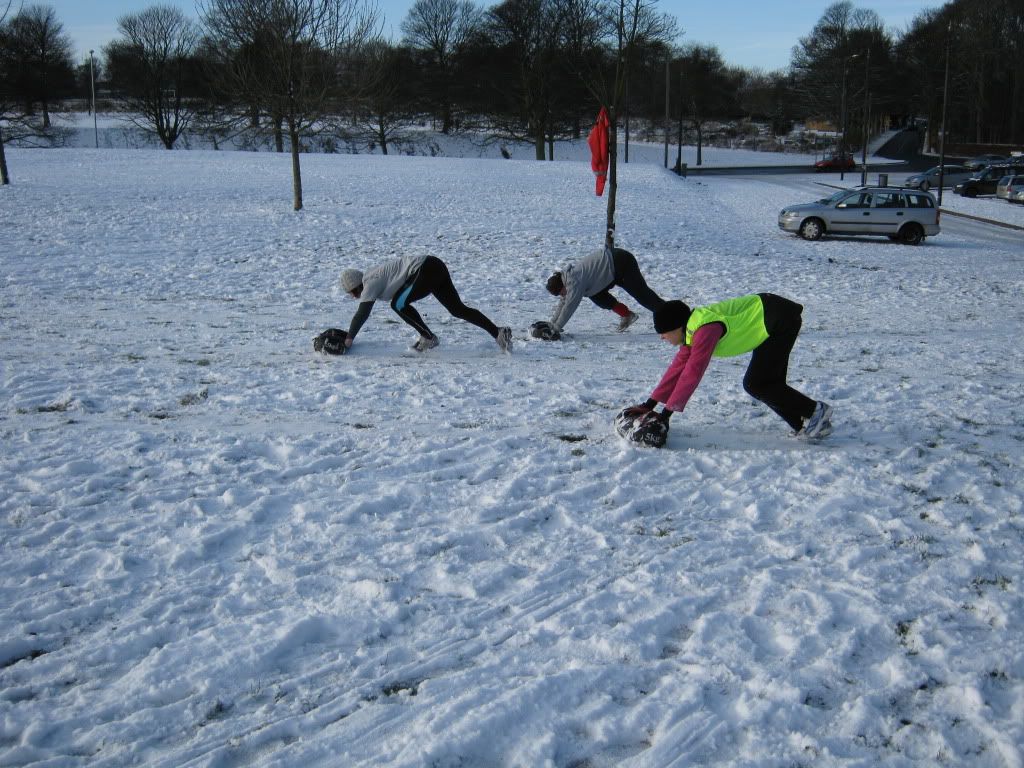
    • If you're wanting to be a little more adventurous then try sleigh pushing. Our outfit members love these, killer exercise but don't half get your body working like never below. We use powerbags but a small badger on a sledge would prove a fantastic alternative

  1. Do a home circuit. You really don't need equipment to get the best workout. The truth is that a lot of the fitness based equipment can distort posture, just check the following video of my brother on a pec dec for some evidence http://www.youtube.com/watch?v=3wWrLA_LT8s. The best tool we all have is our own bodies. Weight can be good but only once you've mastered using your body first. There are loads of programmes out there, from yoga, pilates, simple circuits and all have benefits. However, we've found that whilst each style of bodyweight training has it's own benefits, there is no single style out there that gives you strength, stability, flexibility, body conditioning, aerobic fitness, balance, power and so we put together our very own Primal Flow. Why not try one of our circuits and subscribe to our YouTube channel to receive all our coming programmes. They're short, sharp and maximise using all of your body:
  2. Sort the house out. It could be cleaning, DIY or doing those jobs that you never seem to do. You'll be suprised at how much of a workout spending a morning hoovering, washing, polishing, ironing or cleaning the oven can be. Whilst at Jenny's house recently, my mother-in-law made a very true observation about the rising level of overweight and obese people. People just don't have manual jobs anymore. Spending some time on your feet doing jobs will not only kill the calories but it'll fill you with satisfaction after doing such a great job. 
 Hope this helps!

Monday, November 29, 2010

Avoiding looking like a Christmas Pudding

Christmas is a time for celebrating, spending good quality time with family and relaxing. Having personally spent one christmas out in an area of conflict, it means so much to be able to have everyone I love in the same room and be able to just unwind.

Despite Christmas being just one calendar day, the whole festival stays for weeks if not a couple of months. It's the end of November now and Christmas decorations have been in the shops for weeks and many houses are already complete with tree, lights and more. With this early snow fall - it really does add to the magic of this time of year.

There is one thing to be aware of though through the festive term, watching all those little treats, chocolates, mince pies and glasses of mulled wine. Go on then...just one more!! As well as many houses maxing up with the decorations, one of the unwritten additions seems to be the obligatory tin of never ending fancy chocolates.

If you want to avoid looking like a Christmas pudding come January, here are 5 top tips to keep you on track:

  • 3 is the magic number. As a health practitioner, I could say avoid chocolates, sweets and all those treats and replace them with fruit and nuts, but I truly don't believe in complete abstainence. It tends to result in over indulgence. 3 is a good number when it comes to fancy treats, drinks or other little festive joys. It'll give you the enjoyment without the bloated and over-indulged uncomfortable feeling afterwards. Obviously, this rule wouldn't apply with Christmas dinners...that would be OTT.
  • Drink water! Just because it's cold outside doesn't mean that your body doesn't need hydrating. If you're using hot-chocolate, coffee, tea and mulled wine to keep yourself hydrated then your metabolism will have left the office for the day and your energy levels may go with it. Have a glass / bottle with you an sip regularly.
  • Stay active. It may not be ideal running conditions and your car may be stuck to the driveway but these things shouldn't bring your activity levels to a standstill. Get wrapped up and go for a walk. A good brisk walk is great exercise and for the more adventurous, there are plenty of exercises you can do with no equipment whatsoever at home. Try one of our Primal Flows for size, it takes no longer than 20 minutes and will hit pretty much every muscle in your body. Click here to get stuck in. Alternatively, you could always sign up to our FREE online fitness membership packed with tailored exercise videos, nutritional guidance and progress tracking.
  •  If it snows, get the sledge out! There is nothing better than zipping down a hill with a high pitched scream...expecially as an adult. You'll be surprised how many calories you burn off taking the sledge to the top of the hill again too.
  • Finally, don't skip meals. If you are finding yourself visiting friends and family, being greated with a handful of snacks and not being overly hungry at meal times, avoid skipping meals. Snacks are precisely that and won't provide your body with much in the way of nutrition. Moderate the snacks by sticking to the first tip and be sure to eat decent meals. Freshly cooked with good wholesome ingrediants. Here is a good article with 10 festive meal suggestions.
Please feel free to add comments with your suggestions on avoiding the pudding look.

Wednesday, November 24, 2010

Bootcamps and Fitness Training in Leeds

I read a really interesting article in the Daily express online yesterday regarding bootcamps. You can view it via the following link:

http://www.express.co.uk/posts/view/213103/Are-boot-camps-harmful-

Whilst written by a conscientious fitness professional, the article expresses the concerns of users and potential users of outdoor bootcamps. I completely agree and empathise with the points and questions raised and am taking the opportunity to answer the questions on behalf of our Outfit (www.outfit-uk.com) model but also impartially.

(I'm shortening the questions due to me having limited time

1. Is there screening or individual assessment?

Aside of this being a legal requirement, it would be suicidal for any fitness professional to coach anyone without knowing their medical history, state of fitness and goals as a bare minimum. We of course screen every member and provide an optional full body MOT to all members.

2. Is there insurance?

Again a legal requirement and completely necessary. We ensure that all groups have at least £5 million Liability cover.

3. Is there a free trial session offered?

As a consumer, it is important to try something like this without having to commit with it being a unique service. Furthermore, we feel that contracts can be far too binding and we have a flexible month by month rolling membership to our groups.

4. What are the qualifications and experience of the instructors?

As someone extremely passionate about quality, this is one of my biggest problems with large areas of the fitness industry. People delivering in areas that they are clearly unqualified in. We see it all the time and certainly military bootcamps are particularly bad for this. As a training provider through skills active, quality assurance is paramount to maintain the quality of the values that we started with. All our coaches are fully qualified personal trainers, group coaches, trained on whatever equipment used, first aid trained and have at least 2 years industry experience.

5. How many members are there to every coach?

I've seen classes where 1 instructor is working with 30+ people. In my opinion, this is both unprofessional and negligent. There is no way that even the best coach on the planet can account for that many people ensuring they follow instructions safely and effectively. We operate predominantly on a dual coaching basis giving 2 coaches to every group but even in the event of only one coach being available, we limit the class size heavily. Dual coaching allows us to lead and provide continual coaching on form and technique.

6. Are there weights involved and are the instructors qualified?

This is so important and an area that is potentially more dangerous than just bodyweight exercises. I've seen some awful examples of coaches stepping into areas they aren't trained for. We run a kettlebell instructor course and on numerous occassions, we've had trainers start the course confessing to have used them with clients and by evidence of their technique, they have no idea of how to use them properly. We ensure that all our coaches are fully trained and confident on equipment.

7. Are there alternative exercises for varying fitness levels?

Thinking that one size fits all as a coach is a common mistake and I've seen countless examples where group members are being asked to perform exercises that they shouldn't be attempting.

When classes are run, we always demonstrate with both progressions and regressions allowing members to select the most appropriate level.

8. Are new members able to speak with existing members before joining?

Whilst I've never thought about this before, we always encourage guests to speak with the members on their free taster session. This is something that we'll certainly encourage a lot more proactively as it'll allow members to ask more openly without the fear of being sold at which on today's commercially driven world, is a refreshing opportunity.


- Posted whilst adventurising using BlogPress from my iPhone


Location:Wellington St,Leeds,United Kingdom