Monday, January 17, 2011

How To Use A Foam Roller Safely

More and more people have become aware of the benefits of using a foam roller so I thought I'd put together a quick guide on how to use them to properly. There are loads of great examples on YouTube showing how to actually use a foam roller to target specific muscles in the body. Here is a good example:


Whilst they are very good, it is worth knowing a little bit more than just how to roll on certain areas. Let me explain...foam rolling is all about targetting the myofascial tissue which effectively renders it a massage. Doing this is great as it's where tension builds up and soft tissue is often responsible for imbalances in posture / tightness and soreness. However, doing it in or around exercise can be dangerous without putting a few key elements into how you do it. When you foam roll a specific muscle, done properly will switch the muscle off so it stands to reason that switching a key muscle off prior to an exercise that requires that muscle could be risky.

Here is a simple structure for when foam rolling during or around exercise:
  1. Isolate - Target the specific muscle / muscle group that you're looking to roll and then work across the entire muscle length focussing on areas of greatest soreness
  2. Inhibit - Work between 45-90 seconds on that area to switch the muscle off and release the tension
  3. Activate - Reactivate that muscle by dynamic movements aimed to directly switch back on the muscle working through full range
  4. Integrate - Now integrate the muscle into bigger movement patterns that use the targetted muscle again focussing on full range and good form.
I'll be giving some full examples of this in a host of coming video-blogs that I'll be posting. Hope it all makes sense and fire those questions my way

Tuesday, January 11, 2011

Exercise - Nutrition - Commitment

These are the 3 pillars that we built our company on as, we knew right from the start that achieving success in health is getting the balance between the 3. Taking a stock-check of where you're at is simple and doesn't take any time whatsoever. Here are some really simple tips to make sure that the balance you have of all 3 is taking you in the right direction.


Exercise
  • You commit to a consistent regularity of activities on a weekly basis that includes aerobic exercise, strength activities, flexibility, core and balance. The American College of Sports Medicine (ACSM) guidelines suggest 3-5 aerobic sessions per week and 2 strength sessions. These of course can be merged together.
  • You enjoy the exercise / activities that you do and there is a continual degree of progression / challenge or variation to your activities. If you become bored or feel no progression, change what you do and try new things.
  • The activities don't leave you feeling constantly tired and run down. Recovery is as important as the exercise and the only way that you'll benefit from it.
  • Your activities don't put pressure on your relationships with family, loved ones or friends. Try and compromise to include friends and family within your activities and be willing to change what you do to make it accessible. 
Nutrition
  • How you feel with food can be one of the most telling measures of whether a particular food is good for you. If you feel wrotten after food then the chances are it's not a great choice for you. Always look to better understand which foods sit on your side of the fence.
  • Fuel your body with good clean foods and stick to the 80-20 rule. Eat healthy and well at least 80% of the time and treat yourself from time to time.
  • Drink water regularly.
  • Avoid lengthy gaps between meals or snacks. Fasting for long periods forces the body into a fat-storing state of starvation and unless you're looking to pile it on, try a grazing approach.
  • Eat slowly and balance your portion size. Slowing your eating will help you feel more in touch with when you feel full as well as help the digestion process. Eating until your absolutely stuffed is not the way forward.
  • Aim to vary the fruits and veg that you eat. Get a mixture of colours on your plate and avoid sticking to the same meals and foods constantly
Commitment
  • Without this, the other two elements will struggle. See your journey as exploring your own health and always stick to things that interest, excite and engage you.
  • Although how you see yourself may not seem relevant, we see commitment as mindset and attitude. Like what you see and look at the promise, potential and positives when you see yourself and everything that involves you. If you look in the mirror and dislike the reflection then don't expect weightloss or any transformation to change this fact. We can all connect image with confidence yet it's not the image but the perception of the image that influences confidence. Look at what you have and not what you haven't. Enjoy your capabilities and not things beyond. Believe in improvement.
  • Constantly learning will keep you fresh and vibrant. Equally, passing on your knowledge whilst helping others and teaching will help you develop your understanding.
  • Finally, the journey is always changing with times that are great and times that don't seem as productive. Take responsibility for yourself and everything that you experience and don't blame...not even yourself. Learn lessons, draw from experience and see things from as wide a perspective as possible. Use milestones and set goals but don't get bogged down into focussing on such microscopic details.
There is a lot of scope to make your own sense of what is written above and however that is will be right for you.

Monday, January 3, 2011

A new year - a time for change

An ideal way to mark my 50th blog by starting a brand new, untapped, year with 12 months of completely unchartered territory ahead.

Being new year, typically, people make a hatful of resolutions intending to make a new start for the year ahead and wash away the last. This is often a great thing and allows people to put some new and fresh focus into their lives, however, often in my experience, resolutions are filled with negative statements that include the very thing that people are looking not to do. For example - I'm not eating chocolate! This just puts the undesired activity into the forefront of the mind which isn't such a great idea as the unconscious mind doesn't process negatives. I remember as a child living near to garages that had 'No Ball Games' signs pinned up everywhere. What do you think all the children did? ...precisely what the sign didn't advise.

Here's some simple questions that can help you make sure that your fitness resolutions are strong, well geared and easy to follow. It's best to do this when on your own and with little distractions:


  1. Name an activity that you've either always wanted to do but have never done or you used to enjoy when you were younger and you haven't done in a while?
  2. What would make doing this activity even more enjoyable?
  3. Be brave and put a date to this activity. Month is fine but it's much better to specify the date
  4. If you could select the most ideal physical condition to enjoy this activity, what would it be? (the greater detail the better)
The answers to the above questions will have given you an incredible and powerful resolution that is completely goal specific. Just put them together now and break down some simple steps to help you on your way. 

By committing this to loved ones who you trust, you'll enjoy the support of those around you as well making you more committed to achieving.

Thursday, December 23, 2010

How are you at handling pressure?

We all have good days and not so good days and how we handle the not so good days often has an impact on our health. Sometimes it can even be a direct reflection of our state of health.

Yesterday turned out to be a series of unfortunate events for us, hence this blog. The recent extreme cold weather has been turbulant for so many and it hit us in force. A frozen pipe burst early on, then the freezer broke, then the pipes leaked in about 5 or 6 places flooding the back place and firing water in all directions and then the central heating decided to break down. Whilst it was fairly inconvenient and frustrating, panic just isn't one of my traits. Through the course of the events, there was always tasks that could help reduce the damage or make steps to a solution. In my experience, panicky people make poor decisions and tend not to think straight, I'll elaborate. I am fortunate enough to have served the country twice in the Middle East. Both visits were fairly intense times with a lot of missile attacks on our locations. It got to the point that some people became complacent that the assaults were inaccurate. To be fair, they often were as they were often poorly planned and rushed incidents. As a lead interpreter, I was given a task of showing a new 'terp' the ropes and taking them on an orientation of our base. Whilst at dinner in the mess tent, we came under heavy mortar fire with large shells landing within the camp and extremely close to our location with shrapnel ripping through the tent. The tent provided no protection whatsoever, the problem was that the tent was filled with over 100 soldiers and the exit was a single doorway. You can imagine the situation as dozens panicked running for the entrance, forgetting their armour, running back...it was chaos!

For me, the situation was my first of this kind but I managed to stay calm and get myself and the new and stunned 'terp' to hard cover quickly without panic.

I guess I'm particularly fortunate having this as an experience as I find it easy to put things into perspective. That situation could have been extremely different but I like to think I handled it pretty well.

Things go wrong, expectations get crushed, incidents happen and sometimes it's crucial to act quickly but being able to keep calm and a clear head will help you keep an awareness of what you can do. Panic is fuelled by worry which is focussing on the problem - this can really hamper reaching a solution.

You always have choice and options, make sure you use them.

I know in hindsight, the jets of water flooding our back place will become quite an entertaining story.


- Posted whilst adventurising using BlogPress from my iPhone

Location:Chapel Ln,Leeds,United Kingdom

Monday, December 13, 2010

The biggest mistake in Fitness

As a coach, I guess you can expect me to say that the specifics of the exercise are easy when it comes to staying in shape. It really is though. Even the nutrition can be relatively straight forward providing you don't have specific requirements. If this is the case, why don't that many people seem to achieve the results they so desire? Exercising 4-5 times a week is absolutely ample to either maintain shape or make the changes you want. Yet many people who do commit to this and in many cases even more, what stands in their way of achieving?

When I started out as a coach, I was so excited with all this knowledge I'd recently taken on, all I wanted to do was help people by giving them effective conditioning programmes yet, whilst all this knowledge was great, without one very important thing being right, it wouldn't really make a blind bit of difference. It's mindset!!

I'm not going to profess to always having been the most confident and empowered person. This isn't true. I was never the most physically able at school, in actual fact, chips, gravy and sausage took it's toll on me in my teenage years and everything I'm saying comes with personal attachment.

The thing is, we've all heard about the intrinsic link between mind and body. If you're aware of it but haven't really ever taken notice of it then it may be time to stop and take note. Think about it, in sport, how much does confidence affect performance? In football, when a team concedes a goal, you see their heads go down and this completely disaffects the way that they then play the game. It takes the real leaders / management and coaches to then pick their heads back up. A losing team can often start thinking about not letting another in rather than scoring another.

The good news is, in fitness, you're not having to compete against anyone else. It's just you versus you...you're body versus your mind? Yet, strangely enough, many people have a habit of looking around themselves in a gym or a fitness class and being intimidated by someone else. We've all heard those voices "I'm not that fit / I can't lift that much / I look awful compared to them / I'm never going to be that fit" Don't get me wrong, it can be motivating to work against others in a group context but do you really listen to those voices? If you do then prepare to not enjoy the benefits you should be getting. Those voices don't inspire, make you work as well as you can do or give you the confidence in yourself that you need to be at your best.

Approaching everything you do with focus, self belief and absolute certainty in yourself will make sure that whenever you're training, you're present in not just body but mind as well. It makes a difference...trust me!

If you're interested finding out more about motivation and simple things you can do to improve your mental focus then drop me an email phill@creatingchaos.co.uk

Tuesday, December 7, 2010

The Ultimate Stomach without sit ups - Part 4 of 4

Ok, it's been a few months since I started this series and hopefully long enough for you to have really embedded the fundamentals that I spelled out in:

If you haven't read through those then please take the time to and go through the suggested exercises.

This final step is simple. The golden rule is, use all the tips and techniques you've learnt from the previous articles and apply them to all exercises you do. It is easier to apply the principles for strength training or circuit training but you should still be able to engage them through many forms of CV training.

The most effective exercises that will really engage your abdominals like never before are compound movements that use the entirity of your body and in a variety of directions, movement types and circumstances. If you have a relatively good control over your body then why not try our own Primal Flow system. This is specifically based upon the workings of your stomach and hits every single major and minor muscle group giving you the most rounded conditioning of your stomach possible. No equipment needed. Follow to links to give them a go:

Upper and core conditioning and weight loss - Excellent for toned arms, chest, back, shoulders and one ripped stomach

Lower and core endurance - Perfect to tone legs, bum and stomach

If you find them tricky then try our free online facility which gives you the choice to select your ability level.

Please leave comments and let us know how you get on.

Wednesday, December 1, 2010

Safe exercises when it's snowy and icy

The winter showers seem to have painted the UK white over the last few days and hugely affected peoples plans, work and home life.

If you're finding that the snow is hampering your activity levels at the minute then make sure you read the 3 top ways of staying fit despite the big white outdoors:

  1. Get stuck in - You're never going to defeat the weather so you may as well accept that it'll do it's thing until it decides to do otherwise. Whilst it can be disruptive, snow provides a completely new dimension to training that other weathers just can't provide. Make sure you're wrapped as much as possible (waterproof gloves are best) and try some of the following. (30-40 minutes is plenty):
    • Make a snow man, why not make the biggest snowman/woman you've ever made and better yet, if you are near to another thumb twiddling person, get them involved. Either race to see who can make the biggest and baddest or make an almighty beast together. Incorporating deadlifting, pressing, pulling, twisting and squatting, this task hits all the major movement patterns.
    • Clear the path / drive of snow. It is probably best that you do this one when the snowfall has stopped to avoid frustration but shovelling your paths will not only provide you with a safer thoroughfare but it'll get you working pretty hard. Don't have a driveway? There must be a road nearby, clear a good 10-15 meters of it.
    • Go for an arctic hike. Make sure you are well wrapped up and take some water too. This is better and safer than running in the snow as it is not just slippy but hugely uneven and every step is a gamble whilst not being completely certain of what lies below the snow. Not only will hiking in snow get you working even harder than normal hiking with the deep surface but it'll engage your stomach more with every step having to come higher and further to the front.
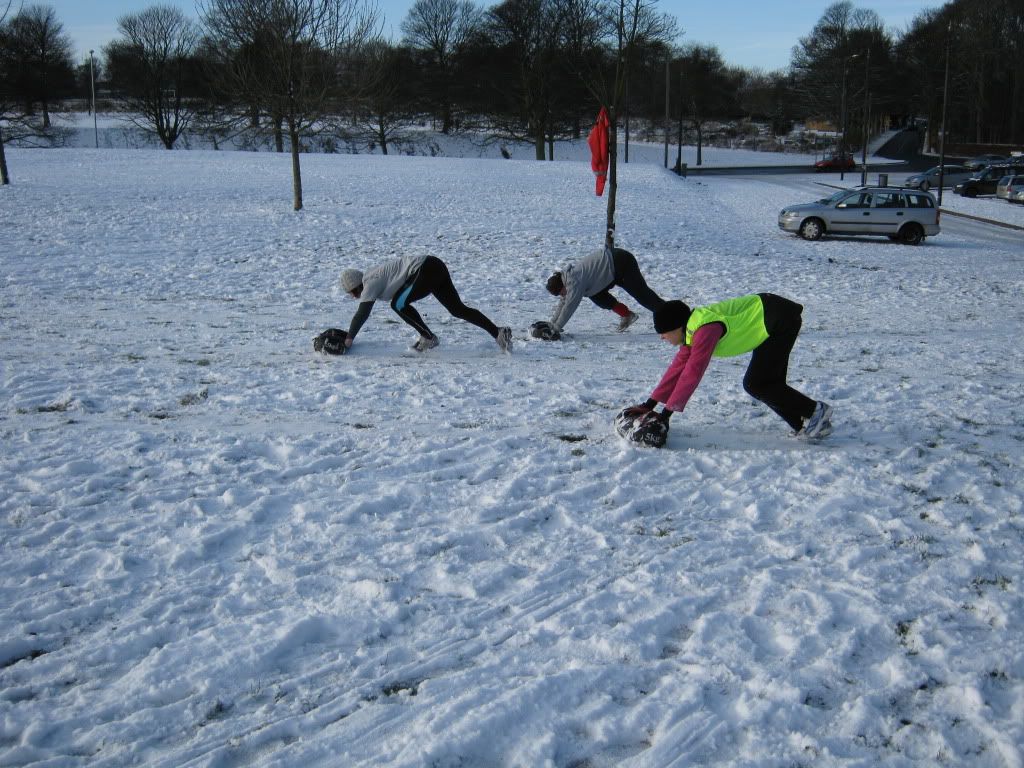
    • If you're wanting to be a little more adventurous then try sleigh pushing. Our outfit members love these, killer exercise but don't half get your body working like never below. We use powerbags but a small badger on a sledge would prove a fantastic alternative

  1. Do a home circuit. You really don't need equipment to get the best workout. The truth is that a lot of the fitness based equipment can distort posture, just check the following video of my brother on a pec dec for some evidence http://www.youtube.com/watch?v=3wWrLA_LT8s. The best tool we all have is our own bodies. Weight can be good but only once you've mastered using your body first. There are loads of programmes out there, from yoga, pilates, simple circuits and all have benefits. However, we've found that whilst each style of bodyweight training has it's own benefits, there is no single style out there that gives you strength, stability, flexibility, body conditioning, aerobic fitness, balance, power and so we put together our very own Primal Flow. Why not try one of our circuits and subscribe to our YouTube channel to receive all our coming programmes. They're short, sharp and maximise using all of your body:
  2. Sort the house out. It could be cleaning, DIY or doing those jobs that you never seem to do. You'll be suprised at how much of a workout spending a morning hoovering, washing, polishing, ironing or cleaning the oven can be. Whilst at Jenny's house recently, my mother-in-law made a very true observation about the rising level of overweight and obese people. People just don't have manual jobs anymore. Spending some time on your feet doing jobs will not only kill the calories but it'll fill you with satisfaction after doing such a great job. 
 Hope this helps!

Monday, November 29, 2010

Avoiding looking like a Christmas Pudding

Christmas is a time for celebrating, spending good quality time with family and relaxing. Having personally spent one christmas out in an area of conflict, it means so much to be able to have everyone I love in the same room and be able to just unwind.

Despite Christmas being just one calendar day, the whole festival stays for weeks if not a couple of months. It's the end of November now and Christmas decorations have been in the shops for weeks and many houses are already complete with tree, lights and more. With this early snow fall - it really does add to the magic of this time of year.

There is one thing to be aware of though through the festive term, watching all those little treats, chocolates, mince pies and glasses of mulled wine. Go on then...just one more!! As well as many houses maxing up with the decorations, one of the unwritten additions seems to be the obligatory tin of never ending fancy chocolates.

If you want to avoid looking like a Christmas pudding come January, here are 5 top tips to keep you on track:

  • 3 is the magic number. As a health practitioner, I could say avoid chocolates, sweets and all those treats and replace them with fruit and nuts, but I truly don't believe in complete abstainence. It tends to result in over indulgence. 3 is a good number when it comes to fancy treats, drinks or other little festive joys. It'll give you the enjoyment without the bloated and over-indulged uncomfortable feeling afterwards. Obviously, this rule wouldn't apply with Christmas dinners...that would be OTT.
  • Drink water! Just because it's cold outside doesn't mean that your body doesn't need hydrating. If you're using hot-chocolate, coffee, tea and mulled wine to keep yourself hydrated then your metabolism will have left the office for the day and your energy levels may go with it. Have a glass / bottle with you an sip regularly.
  • Stay active. It may not be ideal running conditions and your car may be stuck to the driveway but these things shouldn't bring your activity levels to a standstill. Get wrapped up and go for a walk. A good brisk walk is great exercise and for the more adventurous, there are plenty of exercises you can do with no equipment whatsoever at home. Try one of our Primal Flows for size, it takes no longer than 20 minutes and will hit pretty much every muscle in your body. Click here to get stuck in. Alternatively, you could always sign up to our FREE online fitness membership packed with tailored exercise videos, nutritional guidance and progress tracking.
  •  If it snows, get the sledge out! There is nothing better than zipping down a hill with a high pitched scream...expecially as an adult. You'll be surprised how many calories you burn off taking the sledge to the top of the hill again too.
  • Finally, don't skip meals. If you are finding yourself visiting friends and family, being greated with a handful of snacks and not being overly hungry at meal times, avoid skipping meals. Snacks are precisely that and won't provide your body with much in the way of nutrition. Moderate the snacks by sticking to the first tip and be sure to eat decent meals. Freshly cooked with good wholesome ingrediants. Here is a good article with 10 festive meal suggestions.
Please feel free to add comments with your suggestions on avoiding the pudding look.

Wednesday, November 24, 2010

Bootcamps and Fitness Training in Leeds

I read a really interesting article in the Daily express online yesterday regarding bootcamps. You can view it via the following link:

http://www.express.co.uk/posts/view/213103/Are-boot-camps-harmful-

Whilst written by a conscientious fitness professional, the article expresses the concerns of users and potential users of outdoor bootcamps. I completely agree and empathise with the points and questions raised and am taking the opportunity to answer the questions on behalf of our Outfit (www.outfit-uk.com) model but also impartially.

(I'm shortening the questions due to me having limited time

1. Is there screening or individual assessment?

Aside of this being a legal requirement, it would be suicidal for any fitness professional to coach anyone without knowing their medical history, state of fitness and goals as a bare minimum. We of course screen every member and provide an optional full body MOT to all members.

2. Is there insurance?

Again a legal requirement and completely necessary. We ensure that all groups have at least £5 million Liability cover.

3. Is there a free trial session offered?

As a consumer, it is important to try something like this without having to commit with it being a unique service. Furthermore, we feel that contracts can be far too binding and we have a flexible month by month rolling membership to our groups.

4. What are the qualifications and experience of the instructors?

As someone extremely passionate about quality, this is one of my biggest problems with large areas of the fitness industry. People delivering in areas that they are clearly unqualified in. We see it all the time and certainly military bootcamps are particularly bad for this. As a training provider through skills active, quality assurance is paramount to maintain the quality of the values that we started with. All our coaches are fully qualified personal trainers, group coaches, trained on whatever equipment used, first aid trained and have at least 2 years industry experience.

5. How many members are there to every coach?

I've seen classes where 1 instructor is working with 30+ people. In my opinion, this is both unprofessional and negligent. There is no way that even the best coach on the planet can account for that many people ensuring they follow instructions safely and effectively. We operate predominantly on a dual coaching basis giving 2 coaches to every group but even in the event of only one coach being available, we limit the class size heavily. Dual coaching allows us to lead and provide continual coaching on form and technique.

6. Are there weights involved and are the instructors qualified?

This is so important and an area that is potentially more dangerous than just bodyweight exercises. I've seen some awful examples of coaches stepping into areas they aren't trained for. We run a kettlebell instructor course and on numerous occassions, we've had trainers start the course confessing to have used them with clients and by evidence of their technique, they have no idea of how to use them properly. We ensure that all our coaches are fully trained and confident on equipment.

7. Are there alternative exercises for varying fitness levels?

Thinking that one size fits all as a coach is a common mistake and I've seen countless examples where group members are being asked to perform exercises that they shouldn't be attempting.

When classes are run, we always demonstrate with both progressions and regressions allowing members to select the most appropriate level.

8. Are new members able to speak with existing members before joining?

Whilst I've never thought about this before, we always encourage guests to speak with the members on their free taster session. This is something that we'll certainly encourage a lot more proactively as it'll allow members to ask more openly without the fear of being sold at which on today's commercially driven world, is a refreshing opportunity.


- Posted whilst adventurising using BlogPress from my iPhone


Location:Wellington St,Leeds,United Kingdom

Monday, November 15, 2010

The Ultimate stomach without sit ups - part 3 of 4

Now that you've mastered the basics of using your stomach through breathing and core control, we're ready to step forwards to the next level. However, if you're not too confident that you've mastered these key points then I recommend that you spend some more time mastering the movements and exercises from parts 1 and 2.

Assuming that you have done those and you're confident with them, let's turn up the volume a little. You're possibly curious to know what type of exercise I'm going to suggest now to really start working the stomach. It's been such a saturated Market over the last 10-20 years aimed at stomach exercises. From electrodes being stuck to your stomach, ab rollers, specially designed clothing, bizarre footwear to hula hoops and all sorts of other weird fads. The stomach seems to be an area that we're all very conscious and sensitive of. Market history shows that we're willing to spend lots of money on solutions that take away the worry and achieve results. The good news is that you don't have to spend money on anything that will most probably end up in the bottom of the wardrobe.

It may come as a suprise that my exercise of choice for the stomach is the squat. Done properly, this exercise is incredible for the abdominal wall. Firstly, if you've been to a body pump, yoga or circuit class then you may have a very different idea of a squat than what I'm discussing. Watch this short video to make sure we're both clear and singing from the same sheet:

The best exercise for a ripped stomach
Whilst in the video, I'm using a weight (kettlebell) this isn't essential straight away.

The three essentials are the range of movement (all the way down), maintaining a strong and straight spine and finally good breathing pattern.

You may have been told only to squat to knee height or half way down before but you only have to look at any toddler, child or many people living in the developing world to see that squatting almost all the way to the ground is natural to the human body. It is crucial to work through full range for many reasons. One being that it will help prevent your hip flexors from dominating your abdoman during bending forwards and other movements. Furthermore, working any muscle properly, full range is essential. If you have knee, ankle or hip problems and you feel this would cause problems then consult a sports physio or sports therapist first.

Secondly, keep your back extended through the movement. Because we all sit down for hours, our ability to hold the spine in extension unsupported isn't generally as good as it should be. To get the most from the sromach, keeping extension and using the stomach to support this is key.

Finally, use the breathing habits from part 1 in the movement. We suggest that breathing in on the descent and breathing out on the standing phases are optimal, however, this is largely preferential. As long as you breathe and breathe abdominally, you'll be working well internally.

As you become strong and able to work through good range in this movement, look to apply load as the video shows.

When it comes to exercise, always be conscious of the internal workings of the body. Think of it like this, just because a car is moving forwards doesn't mean that it's supposed to be. It could be rolling downhill, it could have been nudged or the breaks may not be working.


- Posted whilst adventurising using BlogPress from my iPhone